Is NIPT the Same as First Trimester Screening
Need an NIPT Test in Dubai ? Contact Us Now
Pregnancy screening can feel confusing when different tests check for similar chromosome conditions. NIPT and first trimester screening both help assess the risk of conditions such as Down syndrome, but they use different methods and provide different information. If you are deciding between NIPT, an NT scan, or combined screening, knowing how each test works can make your next step clearer. Let us look at their differences, accuracy, timing, and when you may need one or both.
Is NIPT the Same as First Trimester Screening?
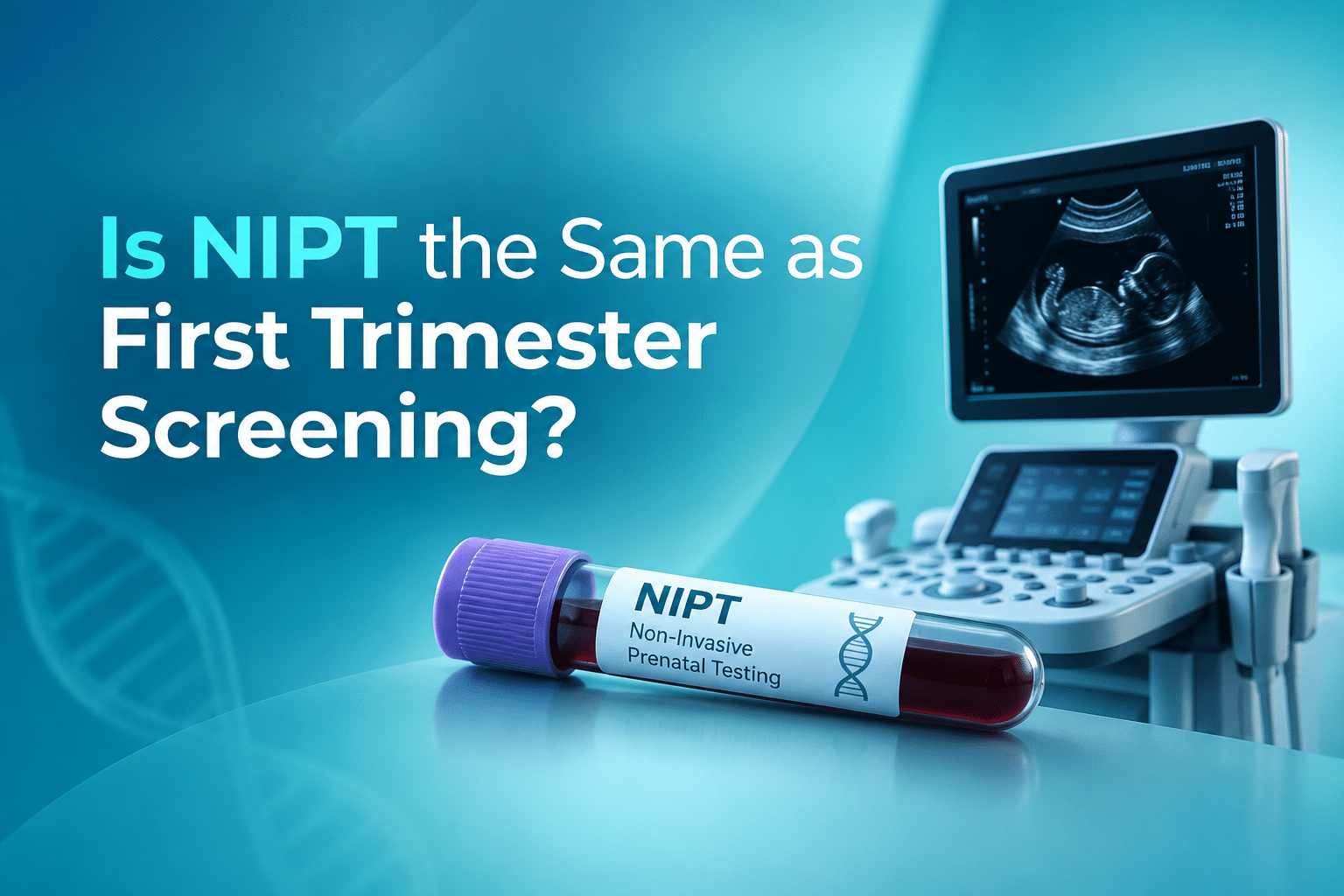
No, NIPT and first trimester screening are not the same test. Both are prenatal screening tests, but they use different methods. First trimester screening combines an ultrasound assessment, usually including a nuchal translucency measurement, with maternal blood tests and other pregnancy information. NIPT uses cell free DNA found in the mother’s blood to screen mainly for common chromosome conditions.
NIPT generally provides more accurate screening for trisomy 21, trisomy 18, and trisomy 13 than combined first trimester screening. However, NIPT does not replace an ultrasound scan. An ultrasound can provide information about fetal development, nuchal translucency, and some structural findings that a DNA based blood test cannot assess.
First trimester screening can therefore provide information from both ultrasound and biochemical markers, while NIPT focuses on chromosome screening through cell free DNA. They have different roles, even though both can be used during early pregnancy.
What Is First Trimester Screening?
First trimester screening is a pregnancy screening approach that combines an ultrasound examination with blood tests to estimate the chance of certain chromosome conditions. It commonly includes nuchal translucency measurement, PAPP A, free beta hCG, maternal age, and other pregnancy information.
What Does the First Trimester Screening Test Include?
The first trimester screening test usually combines an ultrasound scan with maternal blood tests. It can include nuchal translucency, PAPP A, free beta hCG, maternal age, and pregnancy dating. These findings are combined to calculate the estimated risk of trisomy 21, trisomy 18, and trisomy 13.
The combined screening is generally performed around 11 to 14 weeks of pregnancy. The exact timing of the ultrasound depends on fetal size and the clinical protocol followed by the healthcare provider.
What Is a Nuchal Translucency Scan?
A nuchal translucency scan, often called an NT scan, is an ultrasound measurement of the fluid at the back of the baby’s neck. The measurement can help assess the chance of certain chromosome conditions and may also provide clues about some structural problems.
An increased NT measurement does not automatically mean that the baby has a chromosomal condition. It may simply indicate that further assessment is needed, which can include additional ultrasound examinations, screening, or diagnostic testing.
What Conditions Does First Trimester Screening Look For?
First trimester screening mainly assesses the risk of Down syndrome, also known as trisomy 21, Edwards syndrome, also known as trisomy 18, and Patau syndrome, also known as trisomy 13.
The ultrasound can also provide additional information about fetal development and may identify findings that need further assessment. This is one reason an NT scan can provide information that a blood based chromosome screening test cannot provide alone.
What Is NIPT?
NIPT, or non invasive prenatal testing, is a blood based prenatal screening test that analyses cell free DNA in the mother’s bloodstream. It is mainly used to assess the chance of common chromosome conditions and can usually be performed from around 10 weeks of pregnancy.
How Does NIPT Work?
NIPT uses a blood sample taken from the pregnant woman. The test analyses small fragments of cell free DNA, which mainly come from the placenta and circulate in maternal blood. Because the sample is collected from the mother’s arm, it does not require a needle entering the uterus.
NIPT can usually be performed from around 10 weeks of pregnancy. The laboratory analyses the chromosome material in the sample and provides a screening result. NIPT is a screening test, not a diagnostic test.
What Does NIPT Screen For?
Most NIPT tests primarily screen for trisomy 21, trisomy 18, and trisomy 13. These are the chromosome conditions associated with Down syndrome, Edwards syndrome, and Patau syndrome.
Some laboratories also offer expanded NIPT panels that can assess sex chromosome conditions, fetal sex, selected microdeletions, or wider chromosome changes. Not every NIPT package includes these options, so the exact test panel should be checked before testing.
How Are NIPT and First Trimester Screening Different?
NIPT and first trimester screening differ in how they collect information and what they can show. NIPT analyses cell free DNA and generally gives more accurate screening for common trisomies. First trimester screening combines blood markers with ultrasound, giving clinicians additional information about fetal development and nuchal translucency.
The main difference is that NIPT focuses on chromosome screening, while first trimester screening provides a wider early pregnancy assessment through both ultrasound and biochemical markers. Neither test confirms a chromosome condition. A high risk result from either test may require further medical assessment and diagnostic testing.
|
Feature |
First Trimester Screening |
NIPT |
|
Main method |
Ultrasound and maternal blood tests |
Maternal blood test analysing cell free DNA |
|
Typical timing |
Around 11 to 14 weeks |
From around 10 weeks |
|
NT measurement |
Yes |
No, unless ultrasound is performed separately |
|
PAPP A and free beta hCG |
Yes |
No |
|
Trisomy 21 |
Screens for risk |
Higher accuracy screening |
|
Trisomy 18 |
Screens for risk |
Higher accuracy screening |
|
Trisomy 13 |
Screens for risk |
Higher accuracy screening |
|
Structural findings |
Ultrasound can identify some findings |
Cannot assess fetal anatomy reliably |
|
Diagnostic test |
No |
No |
|
Follow up after a high risk result |
May be required |
May be required |
Need NIPT or First Trimester Screening in Dubai?
Amax Healthcare arranges appointments for NIPT, NT scans, and comprehensive pregnancy screening with trusted healthcare providers.
Book Your ScreeningWhich Is Better or More Accurate, NIPT or First Trimester Screening?
For screening common chromosome conditions, NIPT is generally more accurate than combined first trimester screening, particularly for trisomy 21. However, accuracy is not the only factor to consider because the two tests provide different types of information.
How Accurate Is NIPT?
NIPT has a high detection rate for common chromosome conditions, especially Down syndrome. It can provide highly accurate screening for trisomy 21, trisomy 18, and trisomy 13 when compared with traditional combined screening.
However, NIPT is still a screening test. A high risk NIPT result does not confirm that the baby has the condition. A healthcare professional may recommend genetic counselling, detailed ultrasound assessment, or diagnostic testing before a final conclusion is made.
How Accurate Is First Trimester Screening?
First trimester combined screening has lower screening accuracy for common trisomies than NIPT, but it provides useful ultrasound information at the same time. The assessment combines NT measurement, blood markers, and other pregnancy information to calculate an estimated risk.
Its value is not limited to chromosome screening. The ultrasound can identify findings that may require closer assessment, which is information that NIPT alone cannot provide. This is why NIPT should not be viewed as a complete replacement for early pregnancy ultrasound.
If you’re considering NIPT, read our guide to NIPT accuracy, how reliable the results are, and how to choose the right lab: How Accurate Is NIPT? Which Lab to Choose?
Do You Need to Do Both NIPT and First Trimester Screening?
Not every pregnant woman will need the same screening pathway. NIPT may provide more accurate chromosome screening, while first trimester ultrasound can provide information about fetal development and NT that NIPT does not assess.
When Both May Be Useful
Doing both tests may be useful when your healthcare provider wants detailed early pregnancy information alongside highly accurate chromosome screening. NIPT can assess the chance of common trisomies, while the ultrasound can assess NT, fetal development, and certain structural findings.
An increased NT measurement can also require further assessment even when the NIPT result is low risk. The two tests can therefore provide different pieces of information rather than simply repeating the same test.
When Your Doctor May Recommend a Different Pathway
Your doctor may recommend additional or different testing if you have increased NT, an abnormal ultrasound, a high risk screening result, a previous pregnancy affected by a chromosome condition, or other specific pregnancy or genetic findings.
Individual factors can also influence the recommended screening pathway. In some situations, your obstetrician or fetal medicine specialist may recommend genetic counselling or diagnostic testing rather than relying on routine screening alone.
NIPT can provide more accurate screening for common chromosome conditions, but it does not replace an ultrasound examination.
When Should You Have NIPT and First Trimester Screening?
The timing of prenatal screening depends on the test being used. NIPT can usually be performed from around 10 weeks, while the NT component of first trimester screening is generally performed around 11 to 14 weeks. A detailed anatomy scan is performed later in pregnancy.
Pregnancy stage | Common screening |
Around 10 weeks onward | NIPT may be performed |
Around 11 to 14 weeks | NT scan and first trimester combined screening |
Around 18 to 22 or 23 weeks | Detailed anatomy or anomaly scan |
Your obstetrician or fetal medicine specialist can recommend the most suitable timing based on your pregnancy, medical history, ultrasound findings, and the screening options available.
What Happens If NIPT or First Trimester Screening Shows a High Risk?
A high risk screening result can be worrying, but it does not automatically mean that the baby has a chromosome condition. Screening estimates the chance of a condition, while diagnostic testing is used to confirm whether a condition is present.
Does a High Risk NIPT Result Mean the Baby Has a Chromosomal Condition?
No. A high risk NIPT result does not confirm that the baby has a chromosomal condition. NIPT is a screening test that estimates the likelihood of conditions such as trisomy 21, trisomy 18, and trisomy 13.
The result should be reviewed with your obstetrician or a genetic counselling specialist. They can consider the NIPT result alongside ultrasound findings and other pregnancy information before recommending the next step.
What Tests Can Confirm an Abnormal Screening Result?
If NIPT or first trimester screening shows a high risk result, your doctor may recommend genetic counselling and a detailed ultrasound assessment. Depending on the findings, diagnostic testing such as chorionic villus sampling, also called CVS, or amniocentesis may be offered.
These diagnostic tests examine fetal or placental material and can provide confirmation of certain chromosome conditions. Screening results alone should not be treated as a confirmed diagnosis or used as the only basis for major pregnancy decisions.
NIPT vs First Trimester Screening, Which Test Should You Choose?
There is no single prenatal screening test that suits every pregnancy. NIPT may be preferred when the priority is highly accurate screening for common trisomies, while first trimester screening adds valuable ultrasound information through NT assessment and fetal development checks. Some women may benefit from having both, depending on their pregnancy and risk factors. If the NT is increased, ultrasound shows an abnormality, or NIPT reports a high risk result, your obstetrician may recommend further specialist assessment or diagnostic testing before making any decisions.
Making the Right Prenatal Screening Choice
NIPT and first trimester screening are not competing versions of the same test. NIPT offers highly accurate screening for common chromosome conditions, while first trimester screening combines blood markers with ultrasound information. For many pregnancies, the best approach depends on individual risk factors, ultrasound findings, pregnancy timing, and the advice of your obstetrician. Discussing both options with your healthcare provider can help you choose an appropriate screening pathway.
Frequently Asked Questions
Is NIPT better than first trimester screening?
NIPT is generally more accurate for screening common chromosome conditions, especially trisomy 21. First trimester screening also includes ultrasound information, so it can provide findings that NIPT alone cannot assess.
Can NIPT replace the NT scan?
No. NIPT and an NT scan provide different information. NIPT screens chromosome conditions through cell free DNA, while an NT scan uses ultrasound to assess fluid behind the baby’s neck and other early pregnancy findings.
Can I do NIPT instead of the combined first trimester test?
NIPT may be used as the preferred chromosome screening option in some pregnancies, but it does not replace ultrasound. Your doctor can advise whether you should also have an NT scan or another early pregnancy ultrasound.
Is NIPT more accurate than the first trimester combined test?
Yes, NIPT generally provides higher screening accuracy for common trisomies than combined first trimester screening. However, NIPT remains a screening test and cannot replace ultrasound assessment or diagnostic testing when clinically indicated.
Do I still need the 12 week scan after NIPT?
Yes, an early pregnancy ultrasound may still be recommended after NIPT. The scan can assess fetal development and nuchal translucency and may identify findings that a cell free DNA test cannot detect.
Can NIPT detect Down syndrome?
Yes. NIPT primarily screens for Down syndrome, also called trisomy 21, and generally provides highly accurate screening. However, a high risk result does not confirm Down syndrome and may require diagnostic testing for confirmation.
What happens if NIPT is high risk but the ultrasound is normal?
A normal ultrasound does not confirm or rule out a high risk NIPT result. Your doctor may recommend genetic counselling and diagnostic testing, such as CVS or amniocentesis, to establish whether the condition is present.
Safe, Trusted and Affordable NIPT Testing in Dubai
Amax Healthcare helps you access NIPT testing through trusted centres and experienced healthcare professionals in Dubai. We connect you with reliable testing options, qualified specialists, and experienced radiologists for safe and accurate prenatal screening. Whether you need basic NIPT or an expanded screening panel, we help you find an affordable option suited to your requirements. Our goal is to make prenatal testing convenient, clear, and supported by trusted healthcare expertise.